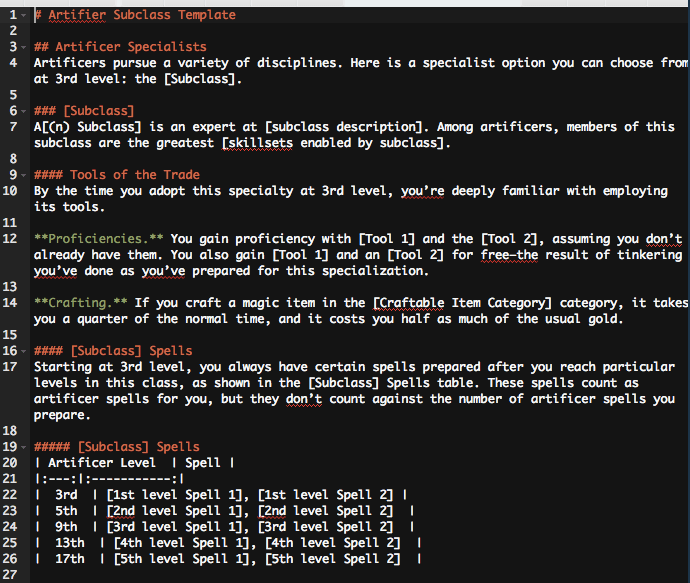
As a follow up to last week's Artificer teardown, we're taking a dive into the Artificer subclasses: Artillerist and Alchemist. We'll analyze the subclasses and develop a template for brewing your own subclasses. Structure The subclass features unlock at 3rd, 6th, and 14th levels. This mirrors the Bard progression, which is notoriously difficult to design … Continue reading Artificer Subclass Template
Artificer Teardown
It happened. On February 28, 2019, The Artificer Revisited was released to much fanfare. What did we get? Let's chew up the crunch. We'll start with the base class mechanics and move into the subclasses next week, when we build a template for how to homebrew an Artificer subclass. Base Class Hit Die (d8). A … Continue reading Artificer Teardown
How To Run A Sandbox
How do you run a sandbox without being completely overwhelmed by the expansiveness? Let's tackle this by dividing it into two sections: planning the sandbox and running the sandbox.
The Hive (Warlock Patron)
Check out The Hive, a new Warlock patron on DM's Guild! This post will be updated with build notes once I've cleaned them up.
The Fletcher (Ranger)
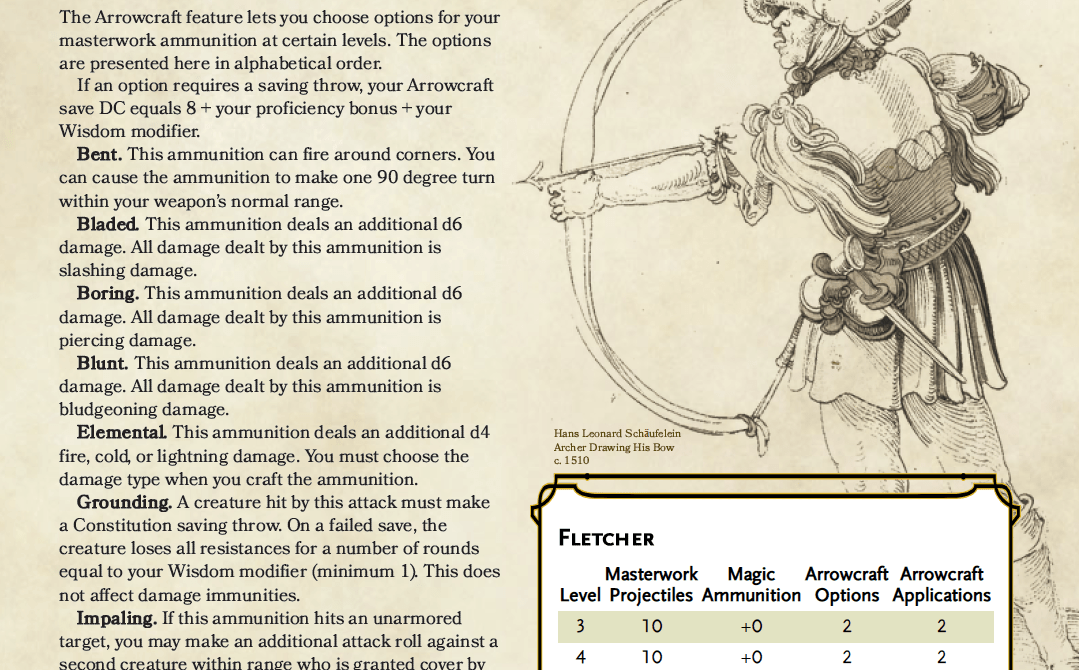
I love the concept of a Ranger that's just out in the wilderness, living off the land. This survivalism should be reflected in the Ranger's craftsmanship. Since most Rangers are ranged attackers, it makes sense that they should be able to craft their own projectiles. Even special projectiles that will help them in the variety of situations they may encounter in the wilderness. Meet the Fletcher!
Kitbashing the Warlord
Among new class options, the Warlord is highly coveted. Especially so among 4th Edition (4e) veterans. In fact, the Warlord is probably the most popular class concept that hasn’t been graced with a playtest treatment via Unearthed Arcana. With no expectations as to when we might see an official Warlord (sub)class, how close can we get with the current options in 5th Edition (5e)?
Martial Adept vs. Magic Initiate
We're comparing the Martial Adept feat and the Magic Initiate feat. While the effect of linear fighters vs. quadratic wizards most often manifests in class design (mostly due to spell access), there’s an interesting reflection of this design in the 5e feats, which we expect to be balanced against each other.
Conditions Chart by Effect
I've digested the Conditions into their various effects: ability checks, attack rolls, attacks against, movement, special attributes (generally aimed at limiting spellcaster efficacy), and what causes them to end. I've also marked an asterisk on the conditions that have incapacitated as a sub-condition.
Druid Wild Shape Options by CR
If you run Druids by-the-book, then they can only Wild Shape into a limited number of forms that the Druid has seen: DMs have a lot of control over Wild Shape. Since the Druid doesn't get Wild Shape until Level 2, you aren't committed to allowing the player a certain number of Wild Shape options … Continue reading Druid Wild Shape Options by CR
Passive Skills vs. Reliable Talent
Reliable Talent makes all your skills passive. In order to see what you're really getting from this class feature, you need to find out what skills already function passively, and what skills only function actively. We'll examine passive skill treatment in the rules and analyze where each skill should fall.